Take the America 250 Challenge!
GPS your family's journey en route to America's biggest Fourth of Julys

America is celebrating its Semiquincentennial. Hooray!
Yet many Americans have struggled this year to reconcile their feelings about the amorphous and tangled 250th year history of the United States of America, especially viewed through the partisan prism of the current administration.
Here’s an alternative: Celebrate it through the unique lens of the Americans who built and sustained this country through good and bad times: your family.
History comes to life through the stories of the people who have lived it. Today most of our forebearers lead a confined afterlife, trapped within picture frames stored in our closets. But if we uncover their stories, we’ll discover vibrant men and women with dreams, ambitions, joys, and heartbreaks, not that unlike our own.
How did the saga of their lives intersect with the watershed moments of our American history? I climbed one branch of my family tree this week, exploring how the Adams family played out their pursuit of life, liberty, and happiness. I invite you to do the same.
In 1789, the year that the permanent federal government was established and George Washington was elected, Ephraim Adams was born near the southwestern frontier village of Bedford, Pennsylvania. Sometime after 1800, Ephraim’s family took a leap of faith, moving to Nicholas County, Kentucky, near Boonesboro, about 350 miles away. There, in 1813, Ephraim married Elizabeth Ann Riley, another Pennsylvania native. My Great-Great Grandfather Elijah Ephraim Adams was born nine months later, in 1814.
America celebrated its 50 year anniversary, called the Jubilee of Independence, in 1826. John Quincy Adams was president, but there was no White House-led celebration. Americans in 24 states rang village bells, town criers spread the word, and patriots displayed the flag, with its 13 stripes and 24 stars. Little did they know that that two of the Founding Fathers, John Adams and Thomas Jefferson, died only a few hours apart on this day. President John Quincy Adams received the news of his father’s death in a letter on July 9.
A few years later, in 1830, the Ephraim Adams family was on the move again. Accompanied by several families, including the Buntins, they pulled up stakes, traveling about 120 miles to Sugar Creek, Indiana, in Boone County. Indiana had been a state for two decades, but it remained a sparsely-settled frontier. Young Elijah bought the first land he ever owned. In 1837, he married Rebecca Buntin, and they made homes in two log houses and two frame houses over the next 14 years, as their family grew to three children. After their sojourn in Indiana, they again braved the hardships and dangers of pioneer life, traveling 160 miles west to Rock Island, Illinois.
Elijah farmed and within a few years, began supplying posts and cord wood for the Rock Island Railway, under construction within a quarter of a mile from their house. The family also boarded railroad workers. The Rock Island line was the first to cross the Mississippi River into Iowa. A fourth child, my great-grandfather Greenbury Elijah, was born in 1853.
By 1855, Iowa’s grass looked greener. Elijah had traveled there a year earlier, buying 320 acres for $3.60 per acre. Along with their 100 head of cattle, nine yoke of oxen, and 23 other pioneers, they began the 200-mile trek.
They crossed the Mississippi on a steam-powered ferry, and continued by covered wagon across the new state of Iowa, traveling through Tipton, Iowa City, Des Moines, Marengo, Newton, and Ida Grove, before stopping on the banks of the Little Sioux River in Woodbury County at Smithland. They built a log house near the town of 25, and began breaking sod. Elijah helped build the first frame bridges across the West Fork of the Little Sioux, as well as the first frame school.
In August of 1855, a prairie fire destroyed 150 tons of wild hay they had mowed and stacked for their cattle. The family survived the historic blizzard of 1855-56, but with only 30 tons of hay, 50 head of their cattle starved and froze in sub-zero temperatures and four feet of crusted snow. Amidst these fraught times, they forged a friendly relationship, trading back and forth, with Inkpaduta and his native American band camped nearby. But in March 1857, Inkpaduta was driven from there by a vigilante militia. From there, he moved north, toward Spirit Lake.
America’s Centennial anniversary was observed in 1876. Three years earlier, on July 4, 1873, Ephraim’s youngest son, known as ‘Lige, had married Ella Ann McClusky. She was 16, and he was 20. Her family had arrived at Maquoketa, Iowa from Pennsylvania in 1854, and Ella Ann (”Nellie”) was born a few years later. Her father, Alexander, born during the 1826 Jubilee of Independence, joined the 22nd Iowa Volunteer Infantry in the Civil War that shook the foundations of this young country.
His wife, Margaret, did her best to maintain the family. In 1863, her brother Calvin Ripple, who served with Alexander wrote home the heartbreaking news that Alexander had died of illness, and he was buried beneath a tree near Young’s Point, Madison Parish, Louisiana. Margaret, with her five children, came by covered wagon to Anthon, Iowa, where their lives intertwined with the Adams family.
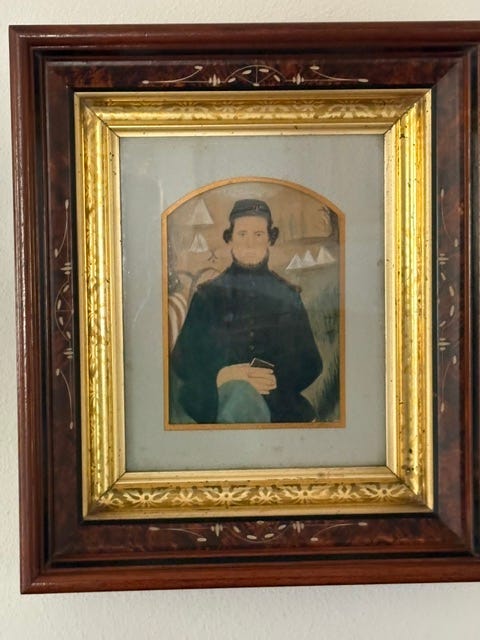
This portrait of Alexander McClusky, painted from a photo, hung on my grandma’s wall near the stairs for decades. Today it’s on a wall in my home
.
Ulysses S. Grant was president in 1876, when America celebrated this birthday milestone by hosting its first world’s fair in Philadelphia, showcasing the latest in technology, science, industry, and culture. The 1876 Centennial Exposition ran from May until December, attracting nearly 20% of Americans; they traveled primarily by passenger train. They marveled at the latest inventions: the typewriter, telephone, Heinz ketchup, popcorn – and more.
But all was not well during this birthday anniversary. Civil War wounds still were fresh. Southern states attempted to take back control through violence in 1875. Following a controversial Supreme Court decision, states began adopting measures designed to keep Black Americans from voting. Political scandals had flourished under the Grant administration (gold, whiskey cartels, and railroad bribes). Amidst charges of fraud and vote tampering. Rutherford Hayes, called Rutherfraud by some, was elected by a bipartisan electoral commission.
In Woodbury County, Iowa, after losing their first child at birth, ‘Lige and Nellie celebrated the birthday of a son in 1876. Soon afterward they moved 25 miles west to begin farming on their own in the Loess Hills near Hornick. They built a house at the base of the bluffs, overlooking the Missouri River bottomland. My grandmother, Margaret Rebecca, was born there. Following the death of an infant sister, “Maggie” was joined several years later by a younger brother.
The 820-acre farm, with its livestock, prospered. Elijah built a spacious barn, placing the name West View Farm on it.
The world was opening up to rural Iowa. The first generation of Iowans built towns along the path of the Rock Island Railway; the second generation built grain elevators along branch lines, and the third generation traveled to distant places via passenger trains.
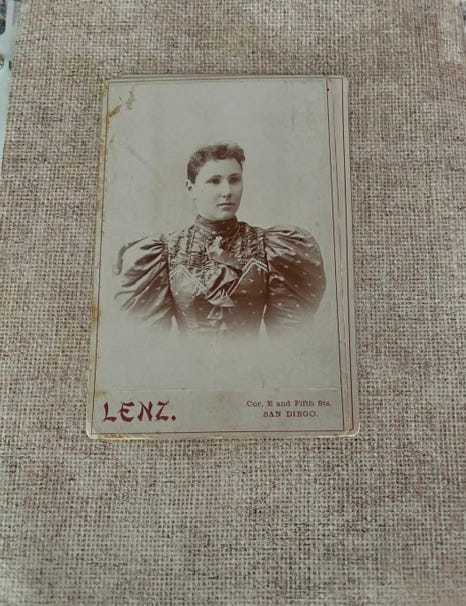
When Maggie was 15 years old, the family traveled by train to San Diego. I have this photo taken of her at Lenz Photo Studio Cor. E and Fifth Ste., SAN DIEGO. In 1893, they boarded the train, headed to the Chicago World’s Fair. Grandma wrote a short journal describing the trip, including seeing Lake Michigan and hearing the new Liberty Bell ring for the first time on September 9, 1893. In the afternoon, they joined the crowd at Buffalo Bill’s Wild West Show, where Annie Oakley performed. Boarding the train for home, they changed cars about 7 p.m. in Manilla, and two hours later, they arrived within 5 miles of home.
Maggie married her neighbor and childhood sweetheart, “Mont” Burns in 1902, and they built a house just east of her parents below the bluffs, where they farmed and raised three children. Two other children died as toddlers. In 1911, Maggie’s parents moved from their farm to Sioux City, where they built a house with a dumb waiter, laundry chute, open staircase, and leaded glass windows.
America’s 150-year (Sesquicentennial) anniversary in 1926. After Warren Harding’s death in office, vice-president Calvin Coolidge became president during the Roaring 20s. The World’s Fair in Philadelphia aimed to celebrate the event, but was plagued by corruption, political maneuvering, and the rainiest summer on record. Strong thunderstorms on July 4 created leaks in pavilion roofs and damaged exhibits. Despite the rapid adoption of the automobile, and new radio stations to spread the word, only five million Americans attended.
Charles Lindbergh was preparing for his solo flight across the Atlantic. The U.S. was only two years away from Black Friday, but the bottom had fallen out of American agriculture in 1920, after WW1. The Good Roads Movement had paved the road passing by the family farm. Maggie and Mont held onto their farm throughout the extreme heat and cold, heavy snow, dirt storms, and grasshopper plagues of the 1930s. The Rural Electric Act made their lives easier. So did Franklin Roosevelt, elected in 1933, who launched federal farm programs as part of the New Deal. My mother, Erma, was in high school when America turned 150.
In 1940, three generations, including Erma, piled into a green Studebaker and spent the next three weeks on a great American road trip: driving over 6,000 miles, through the Black Hills, Yellowstone, the Grand Canyon, Salt Lake City, Colorado, New Mexico, and California. They saw Sally Rand’s Nude Ranch, and visited several wayward Adams cousins who had moved West. My parents married in 1942, moving a small hired-man’s house from ‘Lige and Nellie’s farm onto Mont and Maggie’s farm, where my siblings and I grew up.
‘Lige and Nellie celebrated their 70th wedding anniversary in 1943, with a harpist seated near the open staircase. They still returned to Oak Park in Smithland, along the banks of the Little Sioux River, to celebrate the 4th of July at the Old Settlers’ Picnic. With World War 2 raging on, ‘Lige and Nellie received the tragic news that their youngest grandson, known as “Buddy,” was killed by friendly fire.
Racial segregation ended in schools in 1955, but Civil Rights marches culminated in the Voting Rights Act of 1965. A series of assassinations rocked the U.S.: Martin Luther King, President John Kennedy, and presidential candidate Bobby Kennedy. Secretary of Agriculture Earl Butz urged farmers to plant fencerow to fencerow in 1973. Exports boomed, and land prices began an historic ascent.
America’s Bicentennial Birthday in 1976. The Vietnam War provoked violent demonstrations, reaching its bitter end in 1975. Watergate had forced President Richard Nixon to resign. (I celebrated at the University of Missouri School of Journalism in Columbia.) Gerald Ford presided over the Bicentennial. Women began insisting on more rights, and access to male-dominated fields.
National average gas prices were 59¢ per gallon in 1976. Americans turned out for the parade of 200 tall ships in New York Harbor, a Bicentennial Wagon Train to Philadelphia, and King Phillip and Queen Elizabeth’s visit. A National Archives reading of the Declaration of Independent attracted a huge crowd.
In 1980, President Jimmy Carter was elected, and he declared an embargo on grain sold to Russia. An abrupt hike in interest rates to curb inflation helped precipitate the ‘80s Farm Crisis.
My older brother, Dennis, a United Methodist minister, bought part of Mont and Maggie’s farm in the early 80s. After retirement, he and his wife moved back to the four-generation farm. After his sudden death, his ashes were scattered over
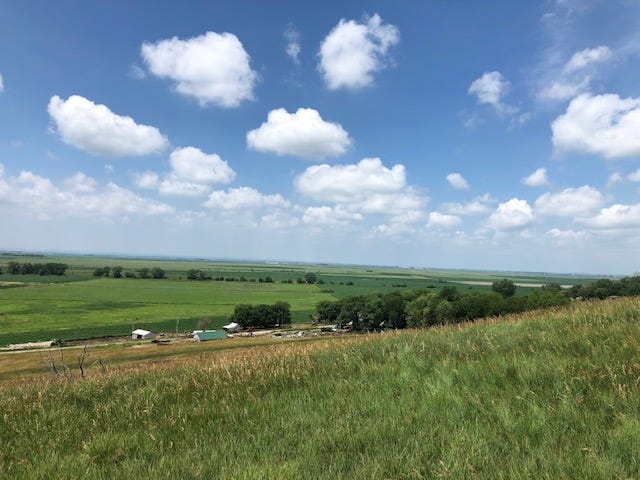
the Loess Hills above the farm.
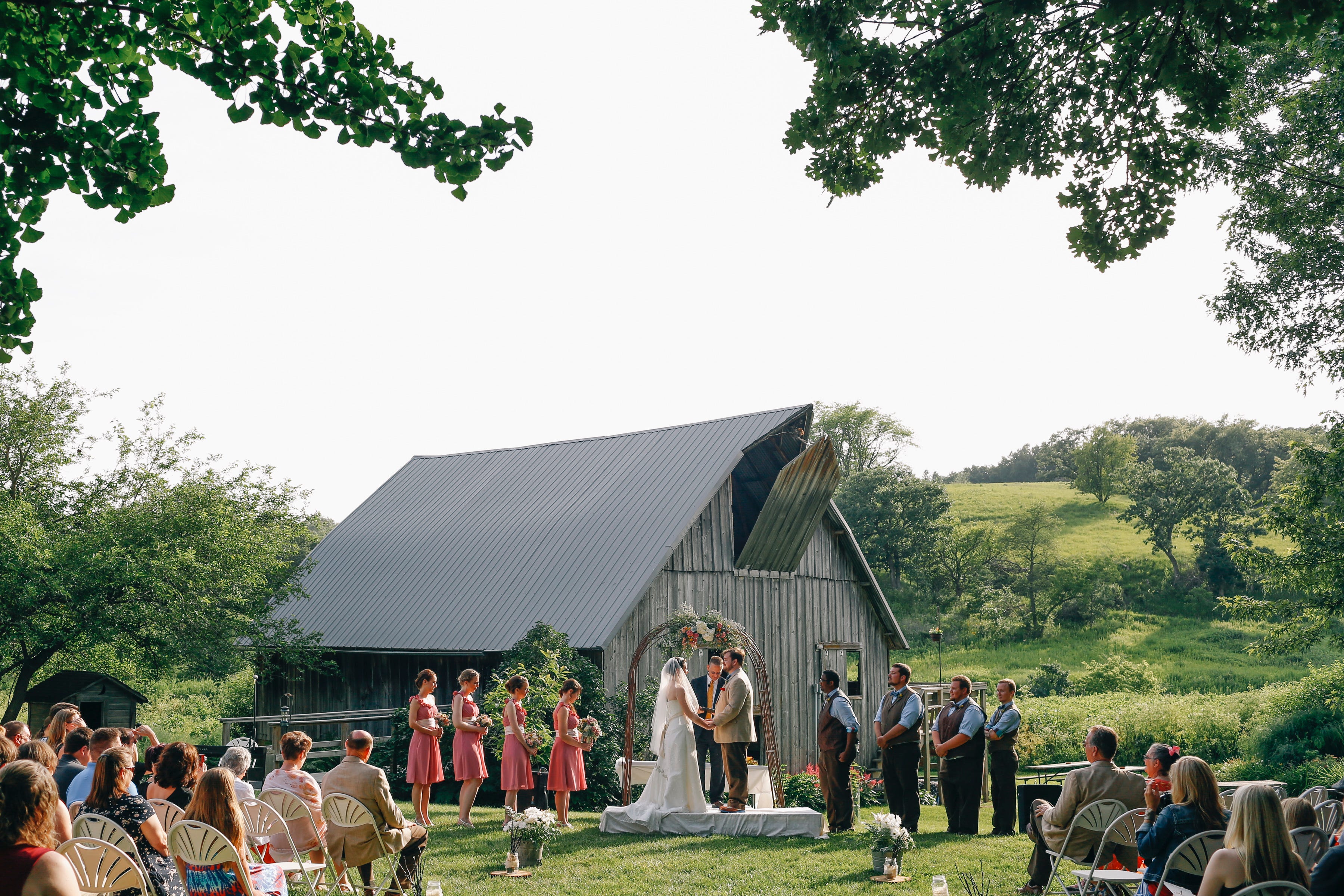
On July 4, 2014, my older daughter, the great-great-great-great granddaughter of Ephraim and Elizabeth Riley, was married at Whiterock Conservancy, with a barn dance following. It wasn’t so different, after all, than the July 4, 1873 wedding of her great-great grandparents, ‘Lige and Nellie, who enjoyed their wedding supper at a blacksmith’s shop, and danced to Uncle Billy Ripple’s fiddling melodies.
Now it’s your turn!
It’s one American story. There are millions of American origin stories. Our Constitution doesn’t apply only to those who arrived here in a covered wagon. It’s for all the McCabes, McGowans, Salamas, Ferraris, Zhangs, and many others who arrived later, in search of a new home. Their stories add to the rich fabric of our nation.
What’s your family’s origin story? Take the America 250 Challenge, and GPS your family’s journey throughout America’s milestone birthdays: 1826, 1876, 1926, and 1976. Your family stories will remind you where you’ve come from. After all, no matter how smart or talented you are, you didn’t get here by yourself, but by standing on the shoulders of the generations who came before you: the generations who struggled through wars, sacrificed during economic crises, and spent their lives working to build safe, secure communities. They endured inept national and state leaders, as well as corrupt American presidents: Harding, Grant, Johnson, Nixon. Washington, D.C. was a swampy place in 1776. It’s still swampy (Drain the Swamp), but for different reasons.
We stand at Crossroads of July 4, 2026. What role will we play in moving our country forward? How will we keep the promises of the Constitution a reality for all Americans and maintain the American dream for generations to come? How will we make our mark on history?
Our ancestors were resilient. They persevered, and so will we, as long as we share our stories.
Cheryl Tevis writes as a member of the Iowa Writers’ Collaborative. Learn more about the group and consider becoming subscribers — for free or for modest fees, your choice — by using the link below here. Your support keeps us writing for you!
Thank you for sharing your family history. It has raised my curiosity about my own life's journey and the factors that led me to where I am today.
I.
Sensational historical family memoir.