She Had a Dream, Too!
Coretta Scott King: Herstory Through Hersongs

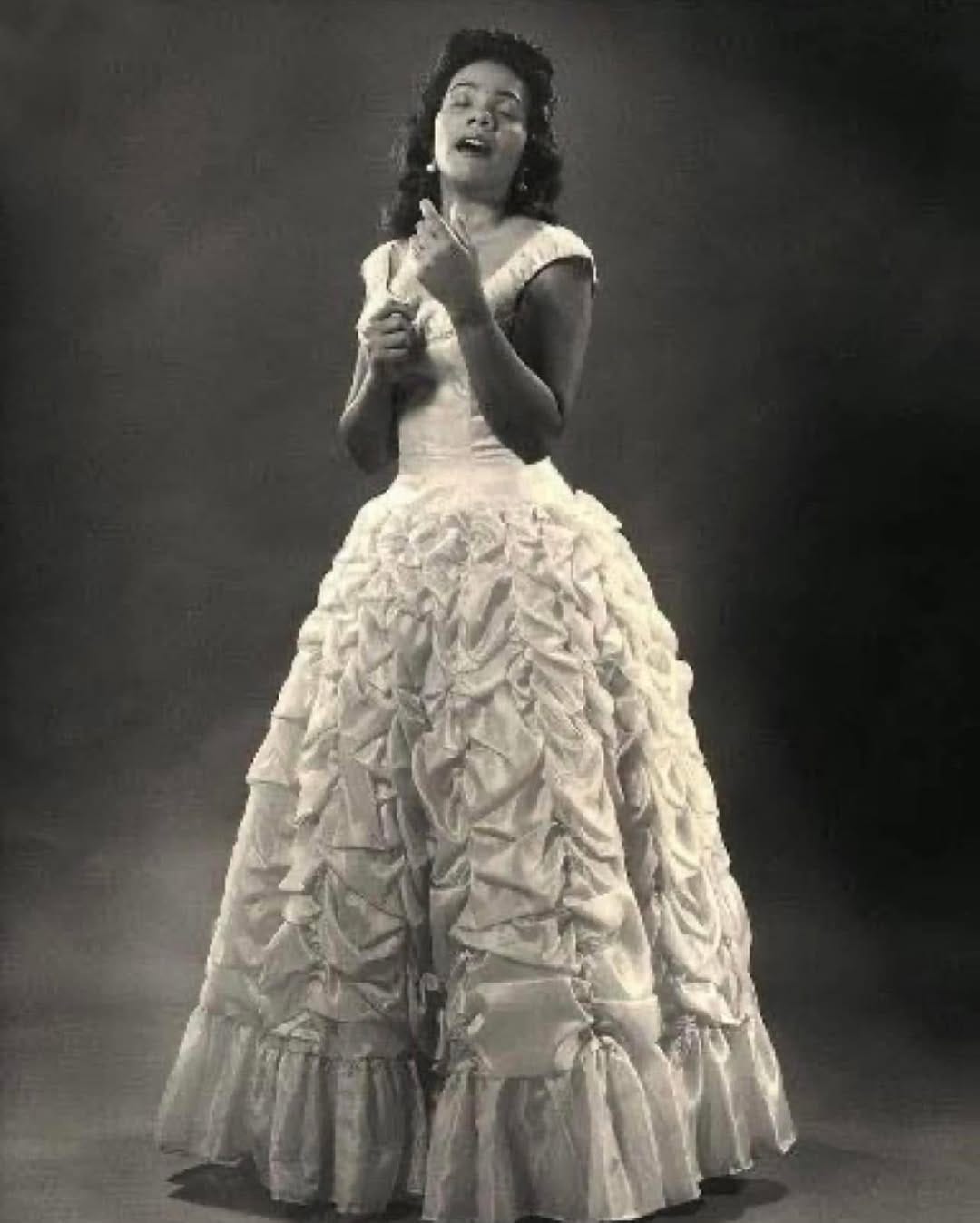
We’ve heard the stories of Mrs. Martin Luther King, Jr., the devoted wife and mother of four children. But what about Coretta, the young woman who removed the word “obey” from her wedding vows in 1953? Or Coretta, the woman who spent 38 years following her husband’s death advocating for an array of causes? There’s much more to know: Coretta Scott King was a force to be reckoned with.
I learned just how much more at the “Celebrating Coretta Scott King: Her Story and Songs” concert at Morningside University in Sioux City earlier this week. This Black History Month event showcased the classical musicianship of Coretta Scott King, and how she used it to advance the cause of civil rights.
The concert was sponsored by the NAACP, Sioux City Branch in collaboration with the Morningside University Dept. of Visual and Performing Arts and the Sioux City Public Library. The event received funding from Humanities Iowa, the National Endowment for the Humanities, and the Federation of State Humanities Councils.
“It’s not just Black History we’re celebrating,” said Tim Steele, an Iowa native who wrote the narration, curated the musical selections, provided musical direction, and accompanied many of the soloists. “It’s truly American history. Instead of erasing it, we should be embracing it.”
My former college roommate, Dr. Marty S. Knepper, Morningside University Professor Emerita, and the sister of Tim Steele, served as project director. She said the convergence of shared personal connections brought this vision to reality:
· Coretta Scott King graduated from the New England Conservatory of Music in Boston in 1954.
· Timothy Steele, a Drake University graduate, has been an active vocal coach, collaborative pianist, and conductor on the opera faculty of the NEC for the past 34 years.
· Bass-baritone Neil Nelson is a NEC graduate, who studied with Steele, and has sung in opera houses across the U.S. and in Russia. However, the Jamaican-born performer didn’t learn until years after his graduation that Scott King also had been an opera student there.
· Marty and Tim’s father, the Rev. Otto Steele, received his doctorate at Boston University’s School of Theology one year prior to Martin Luther King’s enrollment there. Like King, he had a social justice-oriented major, and his dissertation advisor was the same as MLK’s.
· Performer Shannon Salyards Burton, who trained at Boston University, serves on Morningside University’s vocal music faculty.
“My brothers Tim, John, and I grew up hearing the story of Dad ‘s advisor who delivered a tribute at Martin Luther King’s funeral,” Knepper says. “I’ve found that most people did not know Coretta Scott King was a concert soprano.”
A repertoire of 25 freedom songs, spirituals, and art songs, many by Black composers, were key elements of the storytelling, with performances by the Morningside University Choir, directed by Ryan Person and the Gospel Community Choir, directed by NACCP member Sandra Pearson. Other vocal talents included Sioux City native Clark Sturdevant and several Morningside University student performers. The story was narrated by NAACP Chapter President Monique Scarlett.
Early Adversity
Coretta Scott was born on April 27, 1927 in a two-room home on a farm outside deeply-segregated Marion, Alabama, the second of three children. She described herself as “a tomboy and a fighter,” and one day she would draw upon every ounce of these instincts for the life she chose to pursue.
She walked three miles to grade school, and attended Lincoln High School, a black high school in Marion, where she studied music. Her family’s house and sawmill were burned to the ground after her father refused to sell his mill to a white logger.
“I’m just a poor wayfaring stranger traveling through this world of woe. But there’s no sickness, toil, nor danger in that fair land to which I go.”
Poor Wayfaring Stranger, performed by Clark Sturdevant
In 1943, Scott King’s older sister became the first African-American student to attend Antioch College in Yellow Springs, Ohio. Two years later, Coretta graduated as class valedictorian, and received a partial scholarship to Antioch. From 1947 until 1952, she studied music, and elementary education. But she was prevented from student teaching at an all-white school in Yellow Springs. “It was something she never forgot. She didn’t want those who came after her to experience this,” said narrator Monique Scarlett.
She joined the local chapter of the National Association for the Advancement of Colored People, and participated in the Race Relations and Civil Liberties Committees.
In November 1948, Paul Robeson, an acclaimed baritone and leading civil rights leader, was impressed when she performed Poor Wayfaring Stranger and Thanks Be to Thee at an Antioch College event sponsored by the NAACP. He encouraged her to continue her professional studies. She enrolled at the New England Conservatory of Music in Boston, funded by a $650 grant for tuition and fees from the Jessie Smith Noyes Foundation. She arrived on campus with $15, where she recalled living on graham crackers and peanut butter. Eventually she earned money cleaning and doing laundry.
A friend introduced her to ML King, a doctoral candidate at Boston University’s School of Theology. She said she wasn’t interested in dating a Baptist minister. She had in mind a career as a concert soprano.
But King called her, and they met for their first date on the steps of Jordan Hall at the NE Conservatory of Music. They discussed questions of race and economic injustice and the quest of peace. He was immediately smitten with her, and she gradually recognized he was a unique individual.
Married on June 18, 1953, she wore a blue dress, and instructed the pastor, the Martin Luther King, Sr., to remove the words “obey” from their marriage vows. Segregation prevented them from renting a hotel room, so they spent their honeymoon night at a funeral home owned by a friend.
They returned to Boston to complete their degrees. She graduated from NEC in 1954, and he received his doctorate in 1955.
He accepted a call to be pastor in Montgomery, and they made decision to stay in the Deep South. A year afterwards, their first child was born.
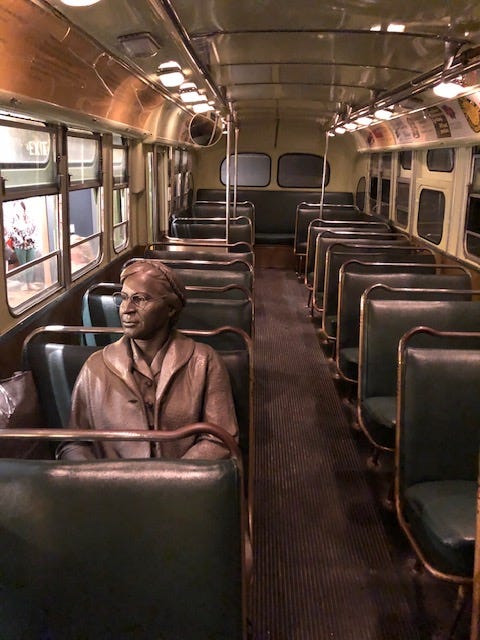
Three weeks later, Rosa Parks refused to give up her seat on a city bus, and changed the course of U.S. history.
“Oh, Freedom! Oh, freedom. Oh, freedom over me! And before I’d be a slave, I’ll be buried in my grave and go home to my Lord, and be free!”
Performed by the Gospel Community Choir and the Morningside University Choir
ML King led the boycott. On January 30, 1956, a bomb exploded on the Kings’ porch, but Coretta and Yolanda escaped serious injury. She lived with the threat of harm, and the worry that her husband might not make it home one day. Segregation on buses was declared unconstitutional on Nov. 13, 1956. As their family grew, she continued to play a role in civil rights campaigns in Birmingham, Selma, and Chicago.
“Precious Lord, take my hand. Lead me on, let me stand. I am tired, I am weak, I am worn. Through the storm, through the night, lead me on to the light. Take my hand, precious Lord, lead me home.”
Precious Lord, Performed by the principal soloists
The Kings left Montgomery in 1960, moving to Atlanta, where he became the co-pastor of Ebenezer Baptist, and their home became an organizing center. Coretta launched a series of 40 Freedom Concerts across the U.S., including songs and narration, and raising $65,000 for the Civil Rights Movement. She traveled to Geneva, Switzerland, serving as a delegate on behalf of Women’s Strike for Peace at the United Nations Disarmament Conference.
“Because I had loved so deeply, because I had loved so long, God gave, in His great compassion, the gift of song.”
Compensation, performed by Allen Quasin
in January 1966 in New Lady magazine, Scott King said, in part, “Not enough attention has been focused on the roles played by women in the struggle. By and large, men have formed the leadership in the civil rights struggle but ... women have been the backbone of the whole civil rights movement.”
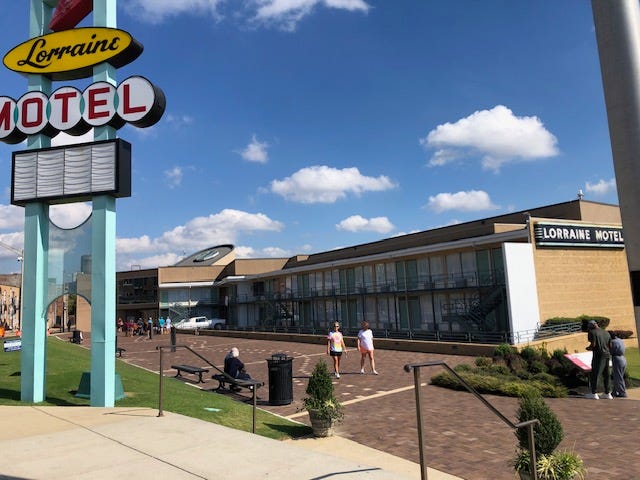
MLK traveled constantly, and often was arrested and jailed. In Memphis to lead striking sanitation workers in 1968, he stepped out onto the balcony of the Lorraine Motel on April 4, at about 6 p.m. The 39-year-old Nobel Peace Prize laureate was killed by a single rifle shot
.
The Struggle Continues
Days after the funeral, Coretta and three of their four children went to Memphis to lead the march by sanitation workers. Later that month, she took her husband’s place at an anti-Vietnam War rally in New York City. Within a year she wrote a biography called My Life with Martin Luther King, Jr., tracing their life together and the Civil Rights movement from Montgomery to Memphis.
She helped launch the Poor People’s Campaign in 1968. She was surveilled for years by the FBI for meeting with a Soviet Union delegation at the Geneva Conference, and her opposition to the Vietnam War.
She threw herself into the founding of the $15 million Martin Luther King, Jr. Center for Nonviolent Social Change. The King Center trained thousands of South Africans in the principles of non-violence. Everyone had predicted massive bloodshed, but there was virtually none when Nelson Mandela was elected President in 1994.
She worked for 15 years to establish the national MLK, Jr. Holiday. Led by Michigan Rep. John Conyers, it was introduced 79 times; Coretta’s efforts collected nine million signatures. It was observed for the first time by Federal workers in 1986, and after another 17 years, all 50 states recognized it.
She campaigned for the Equal Rights Amendment, and for LGBTQ rights. When she died in 2006, at the age of 78 years, 6,000 people attended her funeral, including four U.S. presidents. The Coretta Scott King Center at Antioch College opened in 2007. An annual memorial concert is held at NEC, and a bronze statue of her on its campus features the words, “Continuation of a Dream.” In 2017, a posthumous memoir, My Life, My Love, My Legacy, was published, describing her life following ML King’s death.
Keeping Hope Alive
News of Jesse Jackson’s death broke on the morning of the concert, and the significance of his passing during Black History Month wasn’t lost on the Sioux City audience. Jackson’s legacy was interwoven with MLK. He had marched by his side, and was on the balcony of the Lorraine Motel that night. He called Coretta to let her know what had happened. Jackson’s death, marking the passage of an era of the fight for freedom and social justice, infused a sense of loss into the spirit of the evening.
Attacks on diversity, equity, and inclusion by the Trump administration, and the Iowa legislature also have spilled over into the celebrations of 2026 Black History Month, along with controversies over:
· the removal of the National Park Exhibit honoring servants of George Washington at the President’s House in Philadelphia
· the unapologetic video clip on Trump’s Truth social media account portraying the Obamas as primates
“Civil rights history has a direct correlation to today as we continue the fight for equality and justice for all,” Monique Scarlett said. “While previous generations marched and advocated for fair treatment, today we must stand tall and demand it.”
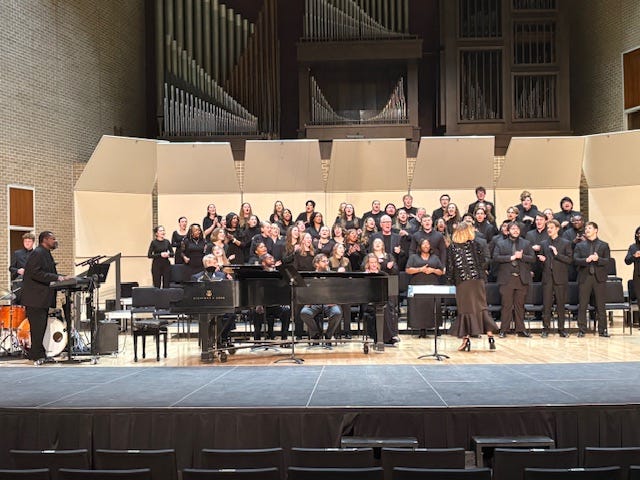
As the concert concluded, as if on cue, the audience rose to its feet, clapping to the contemporary arrangement of the final hymn, performed by the Gospel Community Choir with pianist Tim McGee and drums by Tim McGee, Jr. and conducted by Sandra Pearson.
“We shall overcome. We shall overcome someday. Oh, deep in my heart I do believe that we shall overcome someday.”
“Giving up is not an option,” Scarlett shouted out, as the melody faded into the night.
And all the people said, “Amen.
I’m proud to be a member of the Iowa Writer's’ Collaborative. Meet our writers here, or subscribe to our free weekly roundups, “our Sunday morning newspaper,” and our Wednesday “flipside’ edition featuring sports, music, culture, and other topics. Thank you!
Thank you, Cheryl. I learned so much about Coretta Scott King. I always knew her to be a brave and strong woman. She was all of that and even more. We should know her story.
Thank you for that important history lesson.