Left in the Dark!
Who holds the power in their hands?

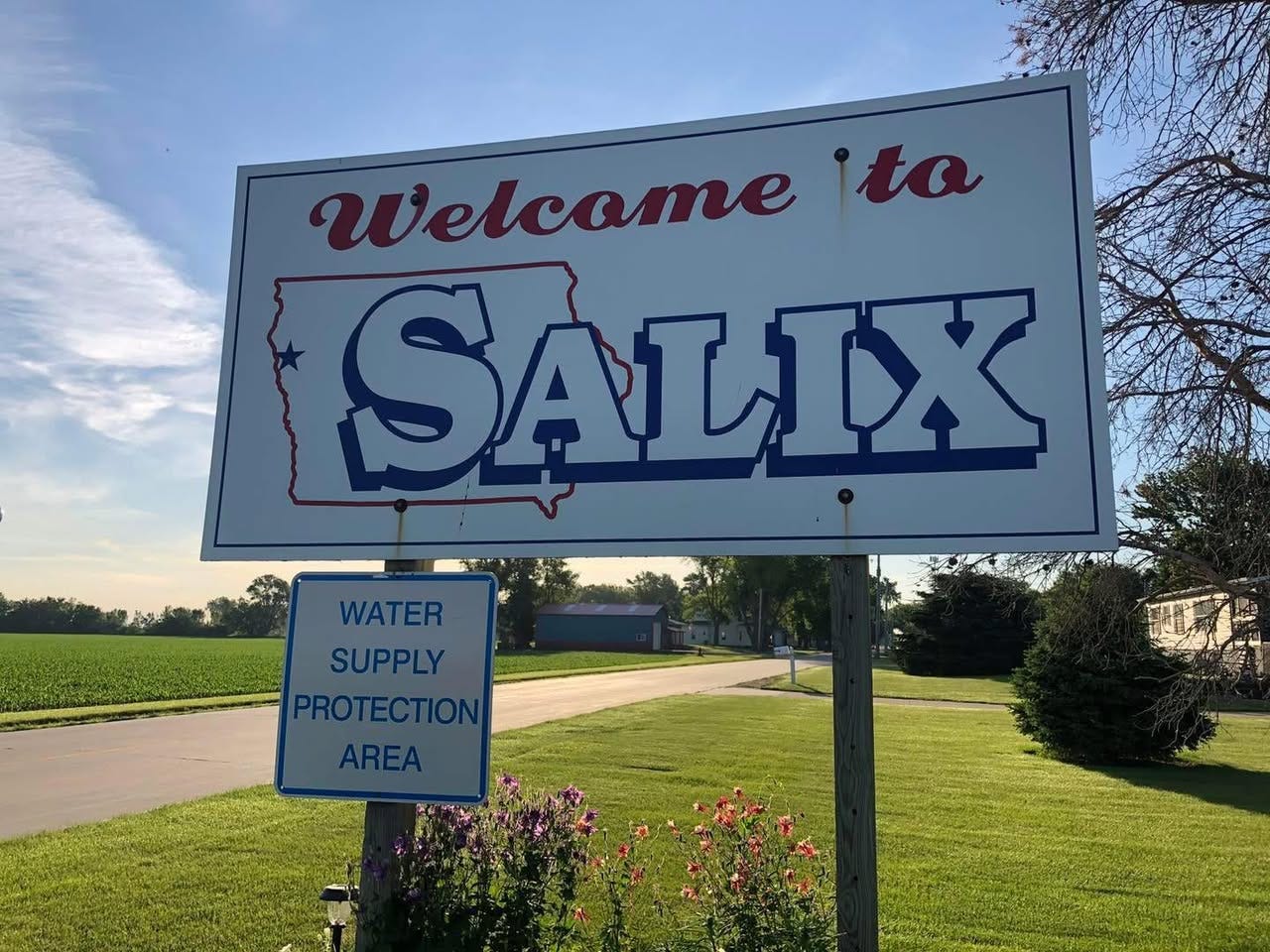
The town of Salix, Iowa, population 304, grew by seven people on May 13.
That’s good news, right?
Not necessarily. The seven new residents previously lived just northeast of town, in rural Woodbury County. They didn’t move anywhere; six of them simply agreed to allow the Salix City Council to annex the 900 acres they own.
When one hundred people packed the Salix City Council meeting to demand answers about future plans for the 900 acres, the meeting was moved to a larger room. However, the topic wasn’t on the agenda, so few answers were forthcoming.
Twenty people were allowed to speak for 45 minutes during open forum. They learned the voluntary annexation was presented to the Salix City Council at the March meeting, and in April, the Council unanimously annexed the property.
They also learned the land currently remains zoned as agricultural, and the Salix city attorney said there’s been no request to rezone. The same landowners still own the land.
“I fully understand that people are concerned about a data center potentially coming into this neck of the woods,” Mayor Kevin Nelson told the residents. “It’s a hot button issue at every level of government, federal, state, and local. And now it’s hitting us in this local area.”
“I would say that a lot of the folks here wanted answers from the city council and thought that they were going to get them tonight, but the city council doesn’t have those answers because there’s been no zoning change requests and no information from the landowners on what their plans are.”
The concerned citizens at the meeting were advised to contact the six landowners for more information.
In response to questions from The Sioux City Journal, a MidAmerican Energy spokesperson said it doesn’t own the land, but an affiliated company holds options on it and other land. These options would “allow flexibility to explore potential future opportunities in partnership with local communities.”
Counties pausing development
The good folks in and around Salix, located 12 miles south of Sioux City, aren’t alone in their frustration and concerns about transparency.
· On May 26, Madison County unanimously passed an ordinance pausing data center development for 12 months during a reviews of its zoning rules.
· May 28, Dubuque County Board of Supervisors imposed a year-long moratorium on data center development. The city manager of Dubuque said a developer was interested in connecting to Dubuque’s water and sanitary sewer systems. The property isn’t contiguous to the city, a requirement for annexation.
· Other counties pausing development or permits include: Adair, Clarke, Buchanan, and Jefferson
· In a recent column I wrote about the fight between Palo and Linn County over a 545-acre Google data center proposed for rural Linn County. Linn County had set up a regulatory framework, including building setbacks, noise limits and traffic impacts. Public records indicated the data center could draw 14 million gallons of water daily from the Cedar River, so the County also required a water use study. Residents also were concerned about potentially higher electric rates. However, Google pivoted, announcing it was working with the city of Palo to annex the unincorporated site in Linn County within the city limits. Palo didn’t have a zoning ordinance governing data centers, but one is underway now.

Impacts on water, environment, and wildlife
Increased water use, power demands, along with land use and zoning, environmental concerns, and community impact lead the list of objections. The following letter from John and Sharon Polifka of Mapleton was published in The Sioux City Journal regarding the potential data center near Salix.
“A private company has plans to build a data center on the 900 acres of land that was annexed to the town of Salix, adjacent to the Owego wetlands. If people might be led to believe that a data center is light industry and harmless, they may be in for a rude awakening.
A data center would pose a substantial threat to the Owego wetlands as a critical habitat for migratory birds (e.g., interference with migration from lights and traffic and window strikes). Aside from the threat to wildlife, data centers use a huge quantity of water to cool their servers (the typical data center uses from 300,000 to 500,000 gallons of water per day. Where do they plan to get that water?
Snyder Bend and Brown’s Lake are virtually dry from past years of severe drought. If they pump the water from the ground it would likely deplete the aquifer and lower the water table. In practical terms, residents in the area could end up losing their wells.
It may be tempting to welcome any economic activity to the area but it comes with inordinate costs. Many people have a stake in this. Therefore, this plan should be vigorously opposed.”
Full disclosure. I grew up in the Loess Hills overlooking the Owego wetlands. Back then, no one called it a wetland, but we knew the water table was exceptionally high. Our family enjoyed reunions at Snyder Bend and Brown’s Lake.
Years later, I recall the fight over locating a large hog confinement there in the 1990s. It was halted. But in 2004, under the guise of economic development, a huge dairy operation was given the green light to operate there. Being in a wetland didn’t prevent it.
Property rights unequally valued
I don’t know if data centers will be a pivotal issue at the ballot box next week, or in November. But I’m betting data centers, along with other large-scale energy usages of farmland, are on the minds of a large swath of Iowa voters.
On Saturday, May 18, I attended a late afternoon legislative forum in Boone where I asked Sen. Jesse Green (R) and Rep. Chad Behn (R) what the Iowa Legislature could do to help rural Iowans avoid situations like the Linn County data center bait-and-switch. They told me the Legislature has been hearing from constituents about data centers, solar farms and wind farms during this past year. I mentioned using Corn Suitability Ratings (CSR) to prevent these developments from consuming prime farmland. They said it had been discussed.
However, Behn said legislators had received “pushback” from some counties and landowners, citing local control arguments: “Who is going to tell us what to do with our property?” He also suggested some local governments were receptive to these developments because it would provide property tax relief.
I pointed out that Iowa has a bifurcated attitude toward private property rights. On the one hand, the Iowa Utility Commission has allowed private companies to use eminent domain to build the Dakota Access Pipeline, as well as the Summit Carbon Solutions Pipeline, despite the protests of private landowners who argue they don’t meet the definition of public use.
Although legislators passed a strong eminent domain law two years ago, the Governor vetoed it. When the House sent it to the Senate this session, majority leader Mike Klimesh rewrote it, and it died a quiet death. Does this show any regard for the rights of property owners?
Now, when property owners agree to sell their land for huge private developments impacting not only the lives of residents, but the water and electrical rates of their surrounding communities, the Legislature suddenly is sensitive to “pushback” from property-owner rights and local control arguments?
Which is it?

Information Black-outs
Data centers may be one issue uniting red and blue state voters. It could be a winning issue for candidates in Iowa.
This power struggle pits farmers, landowners, county and city governments, and communities against one another in a mad scramble to build new motherlodes of power for urban areas, and sometimes out-of-state consumers. These utility-scale industrial energy projects require the same open, level acres highly valued by rural and farm communities.
Recent power plays across Iowa shine a harsh light on conflicts over who controls the land, and who chooses the winners and losers. Is there any comprehensive planning underway to right-size the growth of this AI-hungry industry? What is the impact on our climate goals? What are the true costs of becoming a global AI power?
On the evening of May 17, severe thunderstorms and a series of confirmed tornadoes moved through western Iowa, causing property damage, downed trees, and major power outages. One tornado ripped through Salix, but fortunately, there were no reported injuries or fatalities. Neighbors showed up to help one another recover from the storm – one of the benefits of small-town life.
But the recent tornado damage in Salix may pale in significance to the approaching storm clouds unleashing a powerful struggle. Like the tornado, news of the data center arrived under the cover of night, but without the transparency of Channel KTIV’s First Alert Storm Tracker warnings. Residents will need to stay alert to avoid being kept in the dark.

I’m proud to be a member of the Iowa Writers’ Collaborative. Please check out our work here. Please consider being a paid subscriber. Thank you for your support!
.
Good story. Clearly, something’s going on with that land. No way six adjoining farmers would voluntarily ask to be annexed unless a plan is afoot.
Thanks, Dave. Absolutely, there has to be a substantial amount of money involved!