
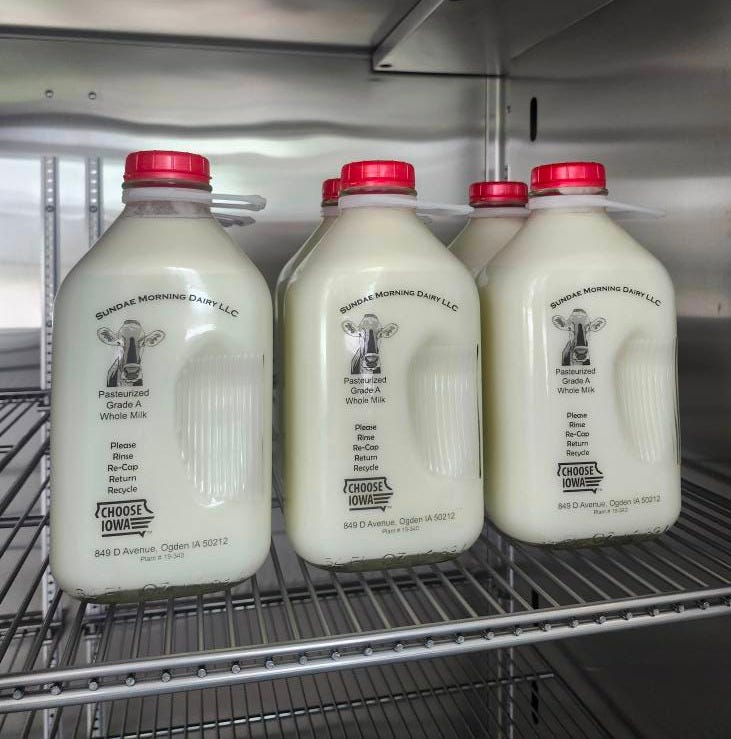
Remember when milk was sold in glass bottles? No? I don’t, either. But today members of our small rural community have the opportunity to get a taste of it.
Spoiler alert: It won’t be delivered to our front doorsteps. But it will be fresh – and local.
In 2019 Erich Hodges received his doctorate of veterinary medicine from Iowa State University. Unlike many other graduates, he didn’t head for greener pastures.
He set up his practice on a farm south of Boxholm, Iowa, on Highway 169 about nine miles from our farm. It’s a little unusual, but not unheard of for a rural veterinarian to work from home.
His practice, Swiss Farm Veterinary, has been a welcome addition west of the Des Moines River Valley in rural Boone County. Over the past several decades, the number of veterinarians, especially large animal vets, has been shrinking nationwide. (Many large-scale livestock operations keep a veterinarian on staff.) But after the Boone vets who treated our livestock retired, their practice was purchased by small animal veterinarians. (Hodges’ practice includes both.)
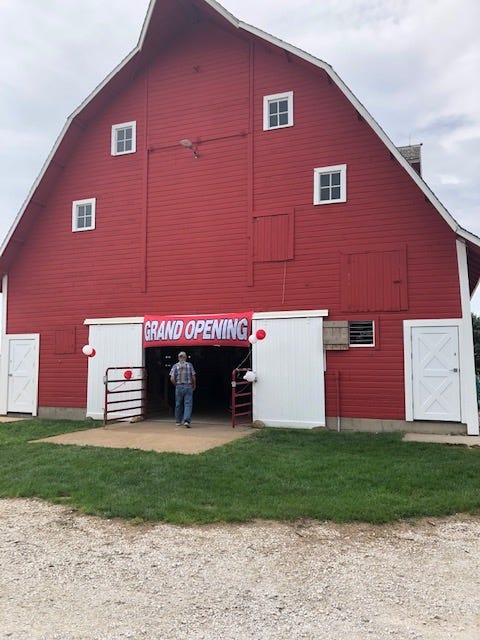
Now he’s milking his initial investment for all it’s worth, and it’s paying invaluable dividends to the community. Dr. Hodges held an open house for Sundae Morning Dairy, LLC last Sunday, inviting members of the community to tour his Brown Swiss micro dairy, and savor fresh samples of their Grade A pasteurized bottled whole milk. It was an udder success!
How now, Brown cow
The backstory of this unusual Iowa venture began near Hockinson, Washington, when six-year-old Erich Hodges told his parents that he wanted to be a veterinarian. His maternal grandparents had emigrated there from Switzerland, where they raised Brown Swiss cattle. His mom Margo Tinner stayed in touch with her Swiss relatives, and nurtured her son’s passion for this breed. He traveled with 4-H state dairy judging teams to competitions, including the World Dairy Expo in Madison, Wisconsin.
After several visits to the Iowa State University campus, Erich enrolled. His parents continued to care for his Brown Swiss cow named Sundae. They often traveled to Ames to visit, getting to know and appreciate Iowa’s rural charms. At the same time, suburban sprawl was overtaking their rural neighborhood. By the time Erich was accepted into ISU’s veterinary medicine school, Iowa had captured his heart.
Soon Erich’s parents began preparing to pull up stakes in Washington, and started searching for the perfect Iowa acreage, not far from Ames. They made an offer on an eye-catching farm in need of TLC in southwestern Boone County. It was turned down, but after three years, they made a second successful offer. They moved here in 2013 with Sundae, and five horses in tow.
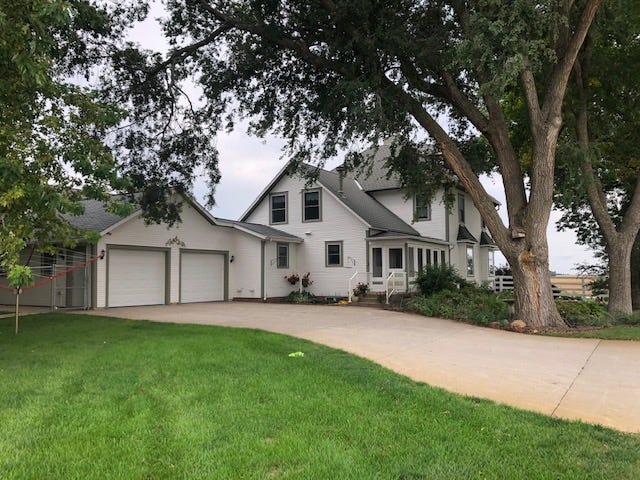
The large stately farmhouse had been renovated as a bed-and-breakfast, but the most compelling feature for them was the farm’s 1908 barn. It once housed dairy cows, as well as Percheron draft horses used in 1930 to grade the Daniel Boone Trail running past the farm as it was paved. The painstaking renovation of the original John and Kate Paulson barn was rewarded by a Small Historic Preservation Project Award from the State Historical Society of Iowa.
Not long after Dr. Hodges decided to set up his veterinary office in the 1899 one-room school moved there by previous owners, he began attending national Brown Swiss sales. Gradually Sundae was joined by Dani, Betty, Sydney, Apple, Victoria, Mischief, and Delightful. Today the herd also includes six heifers and one bull.
He bought equipment from a Wisconsin milk processer going out of business, and stored it for three years. Next, he developed a blueprint for the milking parlor and researched the raft of regulations. A 2023 grant from the Dairy Business Innovation Alliance enabled him to buy equipment to package and process fluid milk and launch his micro dairy last year.
Dr. Hodges maintains a balance between his veterinary clinic and micro dairy with the help of milking assistant Allison Kubiak, who holds a B.S. in animal science and a dairy cattle production management certificate. Two Iowa State University dairy science students work there, along with two high school students who do chores between classes and weekends. “Pasteurization is the biggest challenge,” he told one open house tour group. “it’s an all-day process for 200 gallons.”
Dr. Hodges explained to them how the milk moves through a system of pipes into a bulk tank, and eventually is mechanically bottled and capped, and then stored inside refrigerators in the attached Swiss Milk Hut. It’s a self-serve storefront, and each half-gallon costs $5. Customers can return their glass bottles to reclaim an additional $5 deposit. Each bottle contains the words: Rinse, Re-Cap, Return, Recycle.
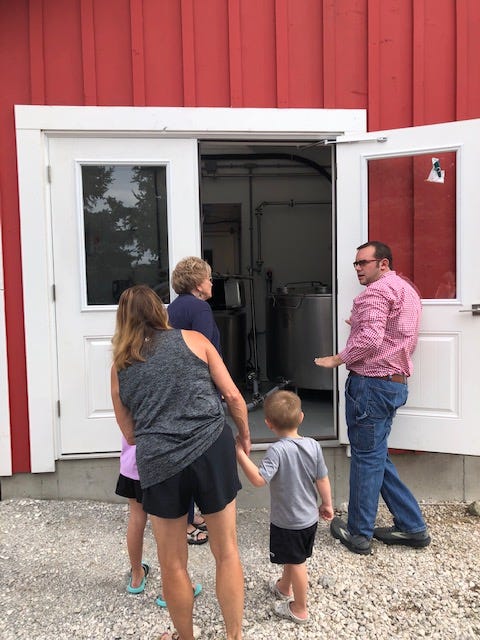
“There are lots of regulations and detailed inspection processes required by the state of Iowa and FDA,” Hodges told his visitors. “We often have little notice when they stop by.”
Whole Milk May Make a Come-back
Micro-dairies are uncommon, especially in Iowa.
In addition to providing a safe, healthy product, micro dairies can be a reservoir for genetic diversity. Most large-scale dairies favor the familiar black-and-white Holstein Friesian breed. Brown Swiss cows are known for their exceptional milk production, longevity, and calm temperament. Other less common dairy breeds are Guernsey and Jerseys.
“Our cows’ butter fat content ranges between 4% to 4 1/2%, and the protein content probably is above what’s in the milk most people buy at stores,” Hodges says. “I think milk tastes better from a glass bottle.”
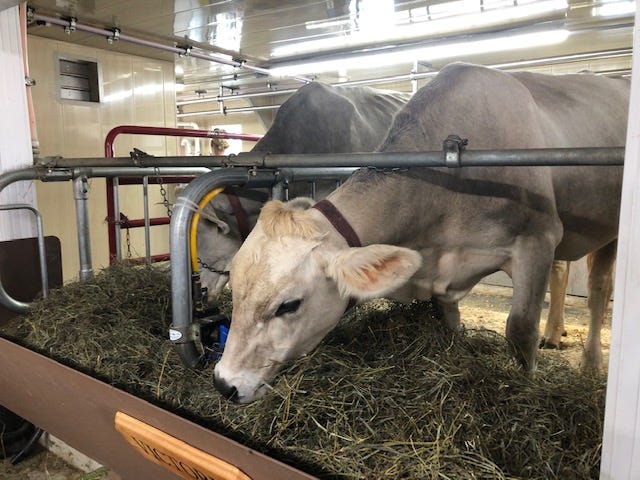
After decades of drinking skim and 1% milk from plastic containers, I sampled the whole milk at the open house, and I agreed. It tasted great!
Sundae Morning Dairy’s timing may be fortuitous. Compared to skim or low-fat milk, whole milk has more saturated fat and calories. The Dietary Guidelines for Americans will be released soon, and it’s expected that whole milk will benefit from the results of a study released in the March American Journal of Clinical Nutrition indicating that it’s “neutrally” associated with the risk of cardiovascular disease. Restrictions on whole milk sales to schools and Federal nutrition programs are likely to be relaxed. (Saturated fat in dairy requires more study, and recommendations depend on your overall dietary intake of saturated fat.)
Buy Local, Stay Small
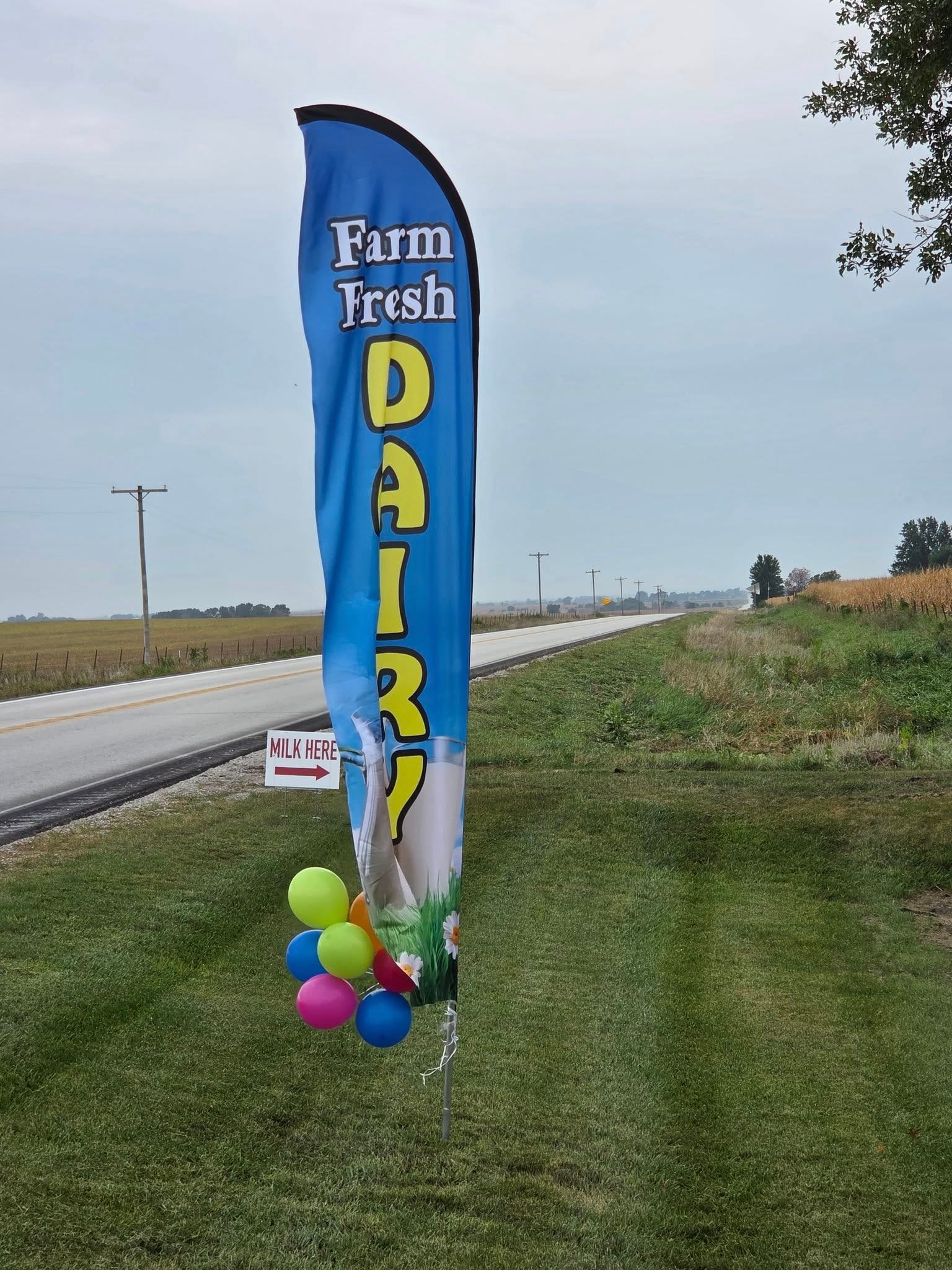
Sundae Morning Dairy is only 3.5 miles north of the intersection of Highway 169 and the four-lane Highway 30 running west of Ogden. The local market may never exceed the micro dairy’s supply of 30 gallons per day. It definitely won’t be supplying milk to the one million square foot Daisy Brand Plant scheduled to open in nearby Boone in 2028. But it’s just the right size dairy farm to remain a good neighbor.
Dr. Hodges buys feed in nearby Dana as well as hay from two local farmers to supplement the cows’ seasonal grazing. “All the ingredients come from within 10 miles,” he says. The farm also is a modest source of local part-time and full-time employment. In a nice tie-in with the farm’s history, Morgan and Delaney, two teenage descendants of the original Paulsons, have “chored” there during their summers and after school.
My visit to this picturesque, historic farm invoked images of All Creatures Great and Small, the Masterpiece Theatre series set in the bucolic English village of Darrowby in the 1930s. But we know being a veterinarian today, especially for large animals, isn’t as romantic as this Public Broadcasting Series (PBS). It’s hard work, sometimes long hours, being on call weekends and evenings, as well as the hazards of dog bites and bodily injuries from large animals. But still, it has its rewards.
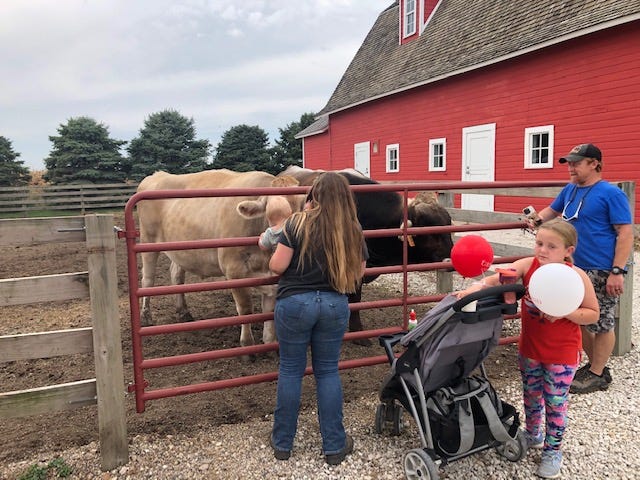
Sundae Morning Dairy amplifies these intrinsic rewards, cementing the direct connections between producers and consumers, as well as the surrounding communities and agriculture. An estimated 400 people turned out to the open house. Young parents brought their children, and older farmers who grew up milking cows by hand gathered to reminisce. It was delightful autumn day to spend outdoors, enjoying the sunshine, socializing with neighbors we seldom see, and watching children learn where milk comes from.
Although Swiss Farm Veterinary and Sundae Morning Dairy have taken root in the fertile soils of Boone County, both must adapt within the context of a larger unnatural world beset by conflicts over vaccines, viruses, nutrition, science, agricultural economies of scale – and more. But the overarching themes of human resilience, the value of personal and family relationships, and the bonds of community reflected by the classic PBS series still can be found here today. You just need to know where to look.
If you want milk, don’t sit on a stool in the middle of a field in the hope that a cow will back up to you. Richard Branson
I’m proud to be a member of the Iowa Writers’ Collaborative. Meet our writers here, or subscribe to our free weekly roundups, “our Sunday morning newspaper,” and our Wednesday “flipside” edition featuring sports, music, culture, and other topics. Thank you!
Thank you for this Cheryl ! We missed the “open house”, but plan to visit and shop there. Also nice to learn what the milk cows are eating! (As in “What Your Food Ate”, previous article).
As one who grew up milking cows by hand, I appreciate all of the work involved in in the process. Thanks for sharing this delightful story!