America's Midlife Crisis
After 250 years, do we have a case of mistaken identity?

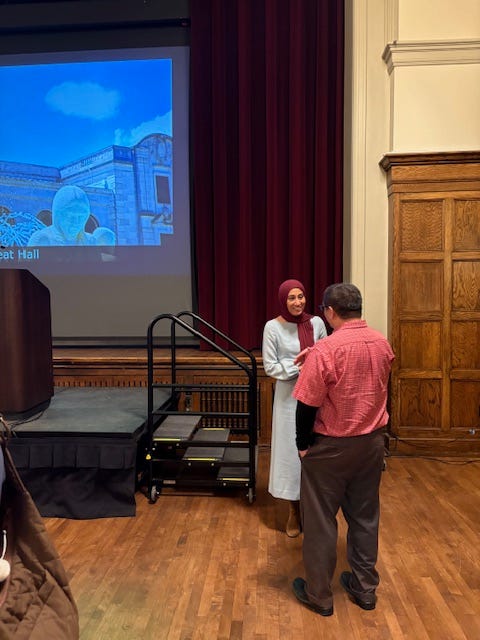
“I’ve been thinking a lot about the sort of letter I would write to my country for its 250th birthday,” Asma Khalid told a large audience at Iowa State University’s Great Hall earlier this week. “Our American experiment is under intense pressure at this moment. But I’d argue this tension isn’t new.”
Khalid, the 2026 Mary Louise Smith Chair in Women and Politics, was a featured America250 lecture series speaker. A frequent guest on national TV news programs, she formerly covered the White House and politics for National Public Radio for years. Today she’s co-host of a new launch, BBCWorld’s The Global Story, a daily news podcast focusing on the intersection of American politics and international events.
Khalid is a native of Crown Point, Indiana, and as a student at Indiana University in Bloomington, she studied at the London School of Economics. She also earned a master of philosophy degree in Asian and Middle Eastern Studies from the University of Cambridge.
Anchored in the nation’s Capitol for most of her journalistic career, she’s traveled the U.S. during national political campaigns, and said it was a “real pleasure” to be back in the Midwest. “I grew up as a Hoosier, but over the past decade I’ve gotten to see America in ways very few other people get to,” she said.
Khalid has crisscrossed the country, observing, reporting, and talking to voters. She is a visibly identifiable Muslim who wears a headscarf.
“We live in an incredibly diverse country,” she said. “Covering campaigns and government over the past decade has made me wonder how we Americans get along. It’s a story that’s been on my mind as the country turns 250 years old.”
She said things began changing during the 2015-2016 campaign. “There was undeniable political angst,” she said. “It was an election cycle when I was shouted off a woman’s doorstep in Ohio for being Muslim. I had to log on or off social media accounts because of the public vitriol being spewed. These things weren’t routine in previous campaigns. But they happened a lot that year.”
Khalid shared a memorable conversation from the campaign trail that year with a middle-aged African-American man. “He told me, ‘We’re witnessing a lot of tumult. America itself was an experiment –we really don’t have a model for our system of government. The U.S hasn’t been around all that long in the grand scheme of history.’ “He said, ‘We’re trying to create an America, something perhaps never done before, that’s a real democracy in a society that’s pluralistic.’ “
He concluded, “We sort of think it will work. The U.S. has not always lived up to its ideals, but for decades it’s worked as a pluralistic, multi-racial democracy. So we kind of think it will continue, because it always has, but what if we don’t put in the effort to keep it alive, and healthy? Who is to say, it will continue to live on in this way?”
Khalid said, “What he said stuck with me – the idea that if we truly want a real democracy in a society that’s pluralistic, it’s not something that’s necessarily achieved through pure inertia. People would need to believe all kinds of ideas and principles could co-exist and be tolerated, even if they do not match their own. It will take a lot of work from all of us.”
She added, “Part of this is about knowing who we are on our 250th birthday, where we come from – our origin story – and how we relate to the rest of the world. It’s a complicated story.”
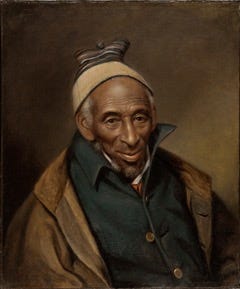
Khalid said stories from the past can help make sense of the current moment in history. She played a clip from The American Muslims documentary podcast airing later this year on PBS to underscore that America has been a mixture of cultures, traditions, religions, and races since its early history. It featured the portrait hanging in the Philadelphia Art Museum of a Muslim man named Yarrow Mamout, painted by the famous Revolutionary era artist Charles Wilson Peale. Mamout was enslaved, but eventually bought his freedom. About 30% of African slaves brought here were Muslim.
Who Belongs? Who Doesn’t?
She highlighted Thomas Jefferson’s ownership of a copy of The Koran that now is housed in the Library of Congress. Ever since he penned the words, “We hold these truths to be self-evident. That all men are created equal . . .”, Khalid said there’s been a tension between what the document says, and what has been practiced, most notably in the days of Jim Crow segregation.
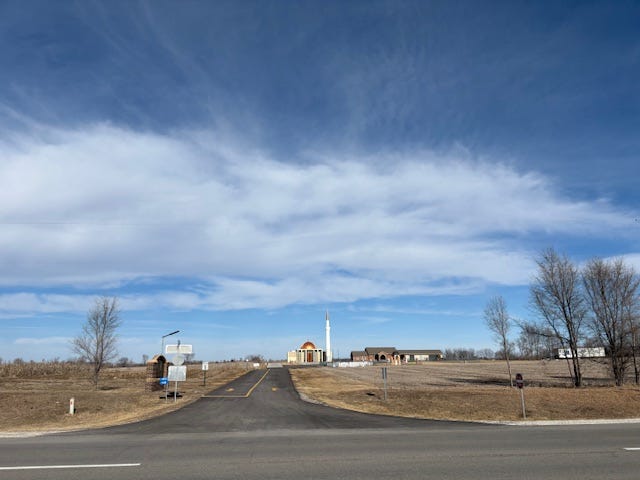
Khalid also has traveled to California to the site of one of the earliest mosques on the West Coast, built in the early 20th century. One of the founders was of Indian origin, a subject of the British Colonial Empire. He married a Mexican woman, although at that time men from the Asian continent weren’t allowed to marry white women. But there were many communities of such intermarriages in the Southwest, Khalid said.
This man often crossed the Mexican border, but racial anxieties had grown since passage of the Chinese Exclusion Act of 1917. On April 20, 1928, he was detained, and brought before immigration inspectors. He was prevented from returning to the U.S., and declared ineligible for citizenship because he was a native of the Asiatic Barred Zone, home to many of the world’s Muslims.
In 1924, Khalid said more than 60 Asians who were already naturalized had their citizenship revoked. “They were uniformly denaturalized,” she said. “The same thing is happening today. Who belongs? Who doesn’t belong?”
Unwelcome in One’s Own Homeland
Another example of how Khalid employed the micro to help understand the macro featured her conversation during the 2015-2016 election campaign with a retired Army veteran at the Red Barn Diner in Manchester, New Hampshire.
She said she was taken aback when he pivoted from their discussion about Mitt Romney and Rand Paul, to ask, “What do you think about Charlie Hebdo?” After she responded it wasn’t a good idea to kill journalists, he asked, “When are all you Muslims going to have your Million Man Muslim March to condemn terrorism?”
She said this anecdote comes to mind when questions are raised about when the political conversation about racial minorities began shifting. “Covering that political cycle like I did, I often say Trump didn’t create the political culture,” Khalid said. “He merely tapped into a pre-existing condition.”
Khalid described her childhood in Crown Point, Indiana as “lovely,” adding that “people were incredibly kind.” Growing up as a Midwesterner, she said she generally believed that “If you’re kind to your neighbors, by and large, they will be kind to you.” But she found it wasn’t what happened in that election cycle.
She said, “One crisp evening fall of 2015, I was a following a young canvasser door-knocking. The woman who answered the door was explaining why gun ownership was her top issue when her mother came onto the porch. She saw me, and started yelling, ‘There’s a Muslim on my front porch, I can’t believe it. You need to get off.’ “
Khalid said, “For the first time I felt that some of my own people despised me. I was born in the Midwest and went to college in the Midwest. I sold Girl Scout cookies in a neighborhood like this one, and the woman reminded me of people I had known all my life. But none of them ever had yelled at me to get off their porch.”
Who Can Be an American?
Khalid said some conversations in Washington, DC portray the U.S in the vanguard of protecting Western civilization, while others see the U.S. in the vanguard of protecting democracy. “There’s a sense at times these two ideas cannot co-exist, nor do people want them to,” she said.
Khalid said this debate seems most raw when it concerns immigration. She played a clip from an interview with Stephen Miller, one of Trump’s top advisors, and a driving force behind the debate. He said the problem arose 50 years ago, when civil rights were applied to immigration policy, “suddenly establishing a global ability of people to come to America, bring their families, eventually emptying out their entire towns and villages to the United States of America,” he said. He singled out Somalians, saying, “Not only is the first generation unsuccessful, but you see persistent issues in subsequent generations, with consistent high rates of welfare use and criminal activity.”
She said President Trump also has implied that only immigrants with a heritage in Western civilization can fully integrate as Americans.
Khalid added the current fight over democracy at home, and what’s going on in the world recently spilled over at a University of Chicago Institute of Politics event, where the question was asked: “Has the U.S. left the group chat room?” Is it abdicating its responsibility?” She shared a thought-provoking question by a student there who asked what it means for democracy at home if the U.S. forms deeper friendships with Hungary and El Salvador than traditional liberal European democracies?
Khalid concluded, “The world is changing. It’s abundantly clear the traditional role of the U.S. in post WW2 is over.” She noted the administration has asserted that America has the right to control the Western Hemisphere. “It’s not clear old friends and allies like Europe are on board with this new vision of the world order,” she said.
“As we turn 250 years, can we preserve our democracy at home, isolated from the rest of the world?” Khalid asked. “To me, it’s increasingly clear, what happens here affects the rest of the world and vice versa. It’s a moment of reckoning.”
America’s Mid-Life Crisis
“Americans have fundamentally different views,” Khalid said. “In many ways as I cover our politics, it seems we’re going through an identity crisis. Maybe it’s a part of midlife, or the natural growing pains of a country that’s still very young.”
She said as the U.S. turns 250, immigration is the issue that most closely connects us to the rest of the world, and it raises these three questions:
· “Who gets to belong here as an American?
· “What does it mean in terms of our values to be an American?
· “What kind of nation do we want to be now?”
“These are existential question as we turn 250 years old,” Khalid concluded.
I’m proud to be a member of the Iowa Writers’ Collaborative. Meet our writers here, or subscribe to our free weekly roundups, “our Sunday morning newspaper,” and our Wednesday “flipside’ edition featuring sports, music, culture, and other topics. Thank you!
Thank you Cheryl. Fear of the other and propaganda about “them” …. are driving a huge dagger in the very concept of America. I know of no way to overcome these forces other than education. All of our political and business leaders need to participate. Will 40% of them continue to bury their heads in the sand and let their hearts turn colder? And if they do, then I guess the burden is on the rest of us to persuade and resist. A very long road indeed.
I was not familiar with Asma. Thank you for telling us about her. She sounds smart and experienced. The comment I feel is most important is how we all must put in the effort to keep America alive - it won’t happen through inertia.